04.03 / FRACTURES & TRAUMA
Dislocations
& Complex Trauma
An injured joint may involve more than a change in position. When bone, ligaments, tendons or nerves are affected together, careful assessment and a coordinated plan protect both alignment and the possibility of useful movement.
01 / THE JOINT SURFACESAlignment & stability
Hand & Wrist
Dislocations
What it is
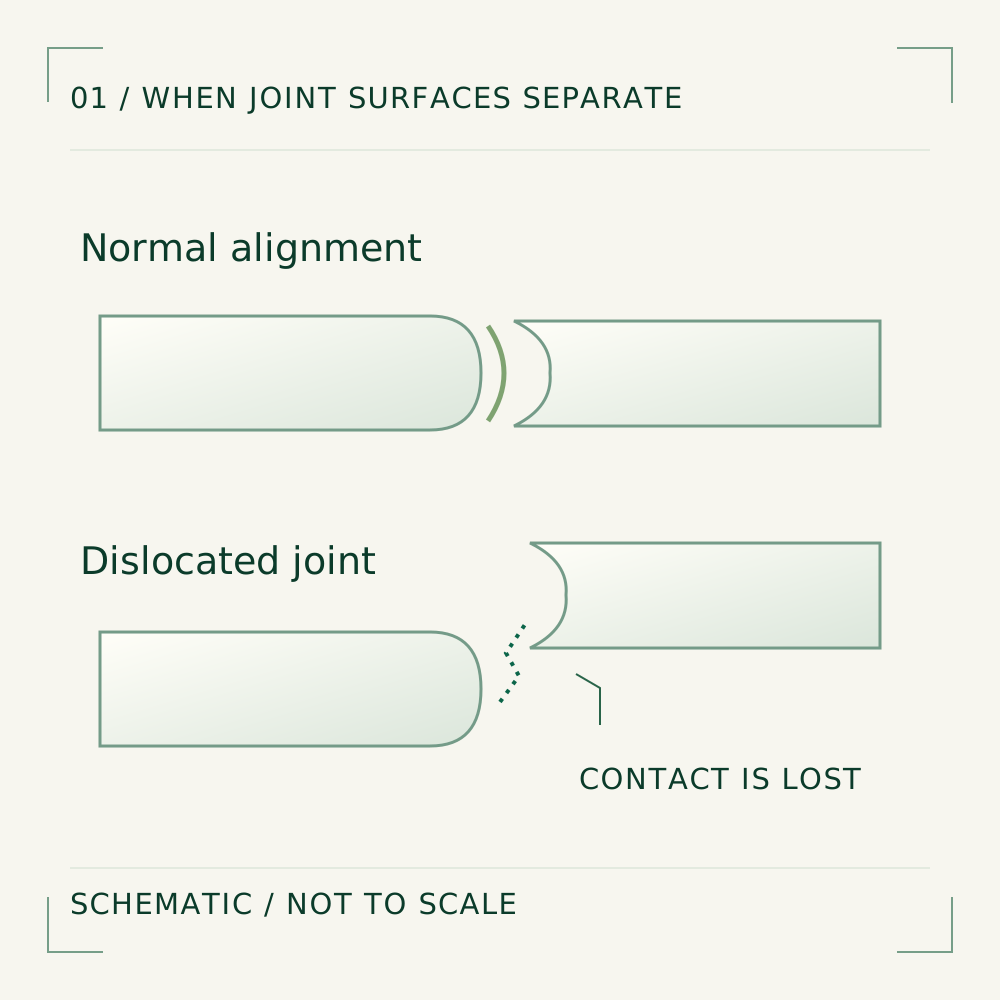
A dislocation occurs when a joint’s surfaces lose their normal relationship. It can affect a finger, thumb or the carpal bones of the wrist. Supporting ligaments are injured, and fractures or tendon damage may accompany it. Restoring position is only the first part of assessing the injury.
1A sudden change in shape or movement
Pain, swelling and difficulty moving are common, with an obvious deformity in some injuries. Bruising, numbness or a feeling that the joint has slipped may occur. If a joint appears to return by itself, associated tissue damage can still need assessment.
2A joint forced beyond its usual range
Sports contact, a ball striking a finger, a fall or a forceful impact can overcome the ligaments that support a joint. Finger and thumb joints may be affected. A fracture-dislocation combines loss of alignment with a break in one of the involved bones.
1The joint involved changes the urgency and treatment
A sporting finger injury and a dislocated carpal joint are different problems. Perilunate injuries involve major disruption around the wrist bones and may endanger the median nerve. These require urgent specialist management, even if the visible deformity seems less dramatic than expected.
3More than a displaced joint
The clinician looks for fractures, torn supporting tissues and damage to nerves or blood vessels. A joint that has been reduced can remain unstable. Treatment therefore considers circulation, sensation, joint stability and soft-tissue injury, as well as whether the bones look aligned.
2Understanding the problem.
Choosing the next step.
Check function before and after reduction
Assessment includes the injury mechanism, skin, finger circulation, sensation and available movement. The team checks alignment and stability after treatment too. Do not repeatedly provoke a loose or painful joint to show the problem; describe what happened and let the clinician examine it safely.
4X-rays and selected additional imaging
X-rays identify the dislocation and associated fractures and are commonly repeated after reduction. CT may clarify complex bony anatomy; MRI or ultrasound is reserved for selected questions about associated injury. Further tests are chosen for what they add to the treatment plan.
4A clinician restores position, then protects it
Many simple finger dislocations can be reduced under appropriate pain control or anaesthesia and then protected in a splint or selected strapping. The position and duration depend on the joint and stability. This is a medical procedure, followed by reassessment, rather than a home manipulation.
1When reduction alone is not enough
Surgery may be needed if the joint cannot be reduced, an associated fracture needs fixation or stability cannot be restored. Major carpal dislocations commonly need operative stabilisation and ligament treatment after urgent initial care. The precise plan depends on the joint and structures involved.
3Protection followed by controlled movement
A therapist can guide exercises and everyday tasks while the injured tissues recover. Too much early movement may risk instability; unnecessary prolonged protection can worsen stiffness. The programme is adjusted to the specific injury and any repair, with loading increased only when appropriate.
4An aligned joint may still need time
Swelling, stiffness or loss of movement can persist. Injuries involving a fractured joint surface may have a greater risk of lasting stiffness or later arthritis. Recurrent giving way deserves reassessment. Recovery and return to sport depend on stability and function, not simply the day the joint was reduced.
1Urgent care comes before a routine appointment
Seek urgent assessment for suspected dislocation, especially with numbness, pale or cold fingers, a wound or severe pain. After treatment, a joint that slips again or a splint associated with increasing pain or altered sensation also needs prompt review.
202 / MULTI-STRUCTURE INJURYA coordinated assessment & repair plan
Complex Trauma
& Reconstruction
What it is
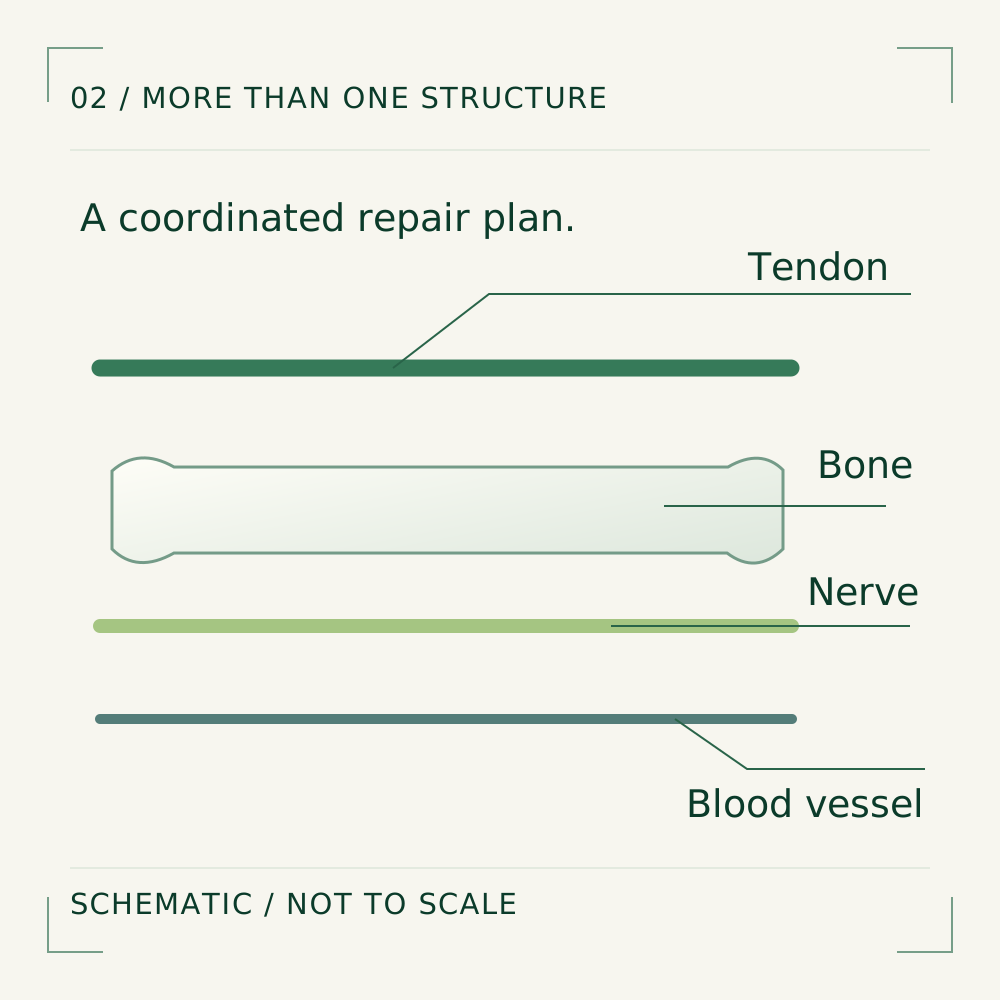
Complex trauma means that several parts of the hand or wrist may be injured together. A fracture or dislocation can accompany tendon, ligament, nerve, blood-vessel or skin damage. The aim is to understand the whole injury and plan care around a viable, aligned and useful hand.
5Several changes can occur together
Pain, swelling and altered movement may accompany deformity or wounds. Nerve injury can add numbness, unusual sensation or weakness. A person may still move part of the hand despite important damage. The pattern must be assessed across individual structures rather than inferred from one movement.
7Crush, cutting injuries and high-energy trauma
Machinery, sharp objects, falls and road or sporting impacts can injure bone and surrounding tissues together. Severe crush injuries may damage tissue over a wider area than is initially apparent. A complex joint fracture can also be serious without an open wound.
5The demands of each hand are different
Complex injuries can happen at work, during sport or in everyday accidents. Treatment planning considers the injury, overall health, hand dominance and practical goals. A reliable pinch, protective feeling or the ability to manage daily tasks may each be an important part of recovery.
8Early priorities: circulation, protection and contamination
Urgent care assesses blood flow and nerve function, supports unstable structures and deals with wounds. Open fractures need prompt treatment to reduce infection risk; antibiotics and tetanus protection are considered as appropriate. Do not delay emergency care to arrange a routine specialist appointment.
6Understanding the problem.
Choosing the next step.
A structured examination of the whole injury
The team checks bone and joint alignment, tendon movement, sensation, circulation and the condition of the skin. The mechanism and wound help guide what may be damaged. Findings may need reassessment as swelling changes or during surgery, so the plan can evolve with better information.
8Investigations should answer a planning question
Some components can be managed with protection
Stabilise bone and restore the surrounding tissues
Surgery may align and fix fractures, clean damaged or contaminated tissue and provide suitable soft-tissue cover. Tendon, ligament and nerve injuries are addressed according to what is viable and repairable. Stabilisation must support the wider reconstruction and the movement that will eventually be needed.
6Repair and reconstruction are different tools
A divided nerve may be repaired directly; a gap may need a nerve graft. Selected cases may benefit from a nerve or tendon transfer to support function. These options are not interchangeable or required for every injury. Their suitability depends on the structures, injury level and time since trauma.
9Why treatment may involve more than one operation
Initial care may prioritise wound treatment, blood supply and temporary stabilisation. Definitive fixation or reconstruction follows when suitable. A single operation cannot always safely address every element.
6Therapy is part of the reconstruction
Hand therapy balances protection of repairs with safe movement and swelling control. Later work may include scar care, sensory retraining and strengthening. A numb hand needs protection from heat, sharp edges and pressure. Exercise restrictions must account for all repairs, not only the bone.
10Progress depends on more than fracture healing
Nerve recovery can take many months and may be incomplete. Tissue loss, joint damage, stiffness and the severity of the original injury affect function. The specialist and therapist review progress and practical goals; recovery may require further procedures, and a return to previous function cannot be guaranteed.
7When urgent reassessment is needed
Seek emergency care for a pale or cold hand, new loss of sensation or movement, uncontrolled bleeding or severe increasing pain after trauma. During recovery, increasing redness, discharge, fever, a sudden loss of movement or an uncomfortable splint should be reported promptly to the treating team.
10THE NEXT CHAPTER / YOUR CARE
After an injury, alignment and function both matter.
Specialist assessment brings the bone and soft-tissue injuries into one treatment plan. Suspected dislocation, a threatened circulation or new loss of feeling or movement needs urgent care rather than a routine booking.
Book a Consultation