05.02 / ARTHRITIS & JOINT DISEASE
Wrist
Arthritis
Several small joints make one remarkably versatile wrist. When their surfaces change, pain and stiffness can limit far more than movement alone. The pattern of damage—and the function you need—guides the next step.

01 / SEVERAL JOINTS, ONE COORDINATED MOVEMENTJoint surfaces & useful range
Wrist
Arthritis
What it is
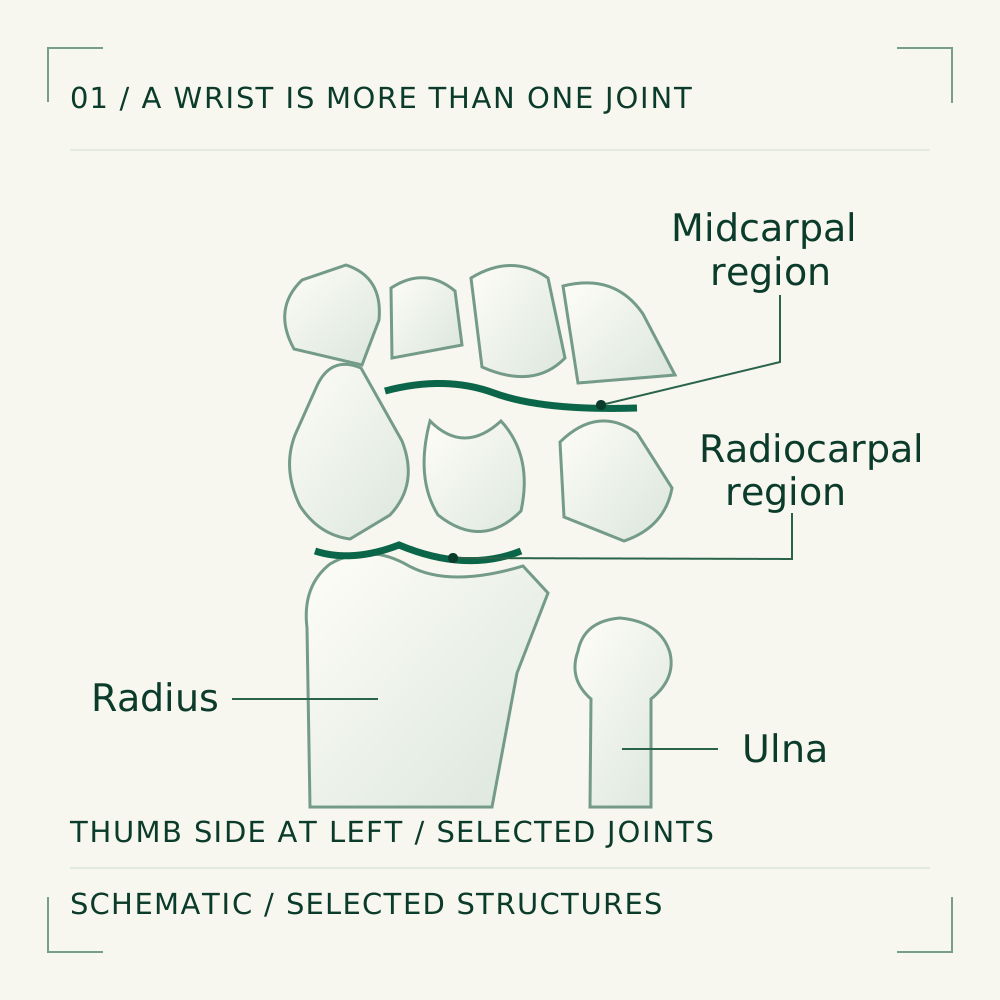
Cartilage allows neighbouring wrist bones to move smoothly. Arthritis can affect the radiocarpal joint, the spaces between carpal rows, or the nearby joint responsible for forearm rotation.
1Pain under load, stiffness after rest
The wrist may ache, swell or become harder to bend. Grip can weaken, and pushing up from a chair, carrying an object or twisting a handle may hurt. Reduced range can interfere with work, sport and ordinary household tasks.
3More than one route to joint damage
Previous injury is an important cause of wrist degeneration. Inflammatory disease can also damage the joint surfaces. These processes are not identical, so assessment looks beyond the general label of arthritis to understand the likely cause and the structures involved.
4The history matters as much as age
Wrist arthritis can affect people with old injuries as well as those with inflammatory disease. It is not exclusively a problem of older age. Asking about past fractures, ligament problems and other painful joints helps place present symptoms in context.
4Describe what the wrist no longer allows
The amount of pain and loss of movement varies. Some symptoms come and go; others persist with ordinary use. Difficulty turning a door handle or lifting a cup may matter more to one person than a limitation during heavy exercise matters to another.
3Understanding the problem.
Choosing the next step.
Movement, tenderness and the pattern of swelling
Examination assesses range of motion, painful areas and the effect on hand use. The history includes morning stiffness and other joints. Blood tests may be helpful when an inflammatory condition is suspected, but they do not replace examination or identify every cause of wrist pain.
3Usually X-rays; selected questions need more detail
X-rays establish the pattern of joint-space loss and alignment. MRI or CT is not routinely necessary to diagnose wrist arthritis. Further imaging may be selected when the clinician needs more detail about ligaments, bone relationships or a particular surgical plan.
1Reducing aggravation while maintaining useful activity
A wrist support, modified tasks and an appropriate exercise programme may help. Pain relief or anti-inflammatory treatment is chosen with other health conditions and medicines in mind. The goal is to make daily use more manageable; persistent pain should prompt reassessment rather than increasingly forceful exercise.
3Relief can help without changing the underlying wear
A corticosteroid injection may temporarily reduce joint inflammation. Response varies; it does not rebuild cartilage. The likely benefit, target joint and possible complications should be discussed first.
1Preserving motion where the remaining surfaces allow
Depending on the pattern, removing selected carpal bones or a partial fusion may retain some wrist movement. A total fusion sacrifices wrist bending for stability and pain reduction; the fingers can still move and forearm rotation is usually preserved. Wrist replacement is an option for carefully selected patients. Each choice has limitations and risks.
5Protection is followed by guided movement
The postoperative programme depends on the procedure. After replacement, for example, a period of protection is followed by prescribed movement and a gradual increase in use. Swelling and scar sensitivity can persist. Wound concerns or unexpectedly increasing pain should be reported to the treating team.
6Agree the trade-offs before treatment
Recovery varies with the operation, damage and activity demands. Therapy cannot restore motion through a fused joint. Heavy work or sport may need lasting adjustments, and pain relief is not guaranteed.
5When limitation outweighs the benefit of current care
Specialist review is appropriate if pain or stiffness continues to restrict daily use despite reasonable non-operative measures. The discussion should include the movements you want to preserve, the severity and location of damage, rehabilitation and the practical consequences of each option.
5Sometimes the treatment team needs to be wider
Inflammatory arthritis may require rheumatology care and disease-modifying medicines. Surgical assessment can address local damage or loss of function, alongside treatment of the underlying condition.
102 / WHEN AN EARLIER INJURY CHANGES THE JOINTPrevious damage & present function
Post-Traumatic
Arthritis
What it is
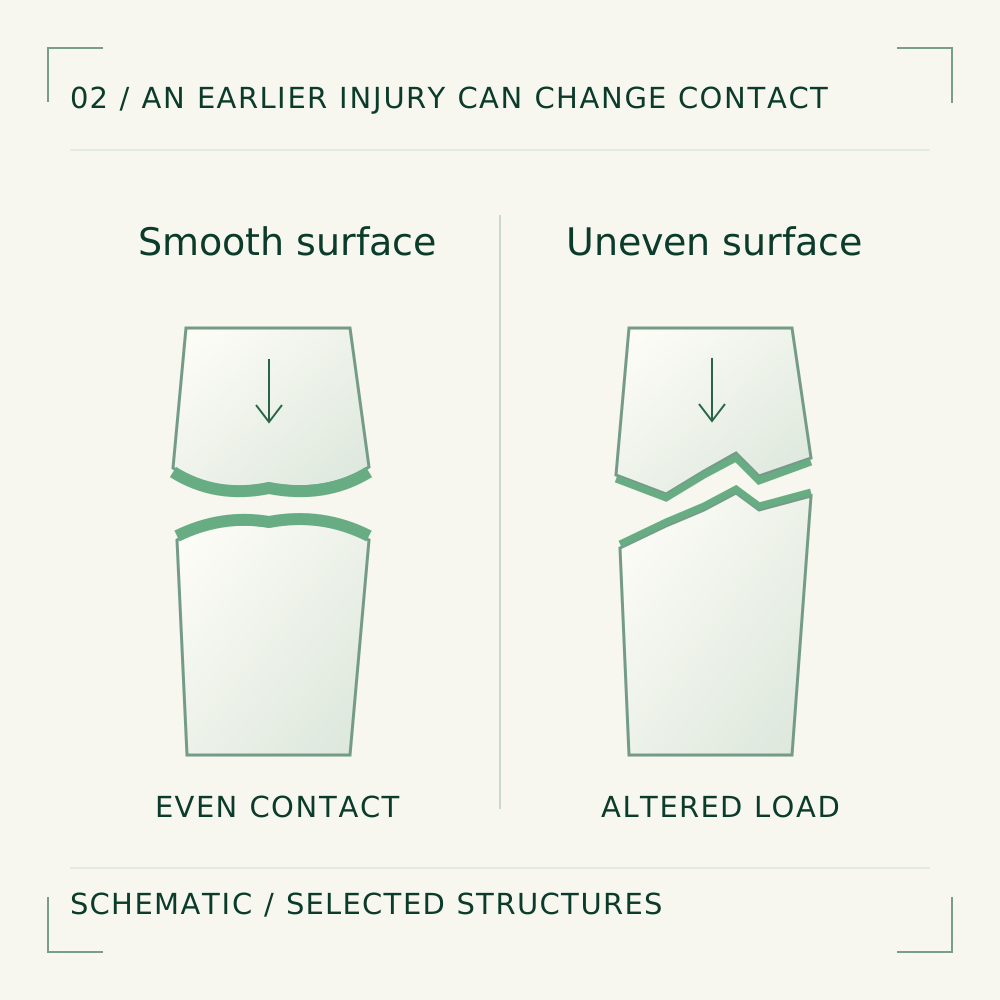
Post-traumatic arthritis is joint degeneration related to an earlier injury. In the wrist, a fracture or ligament injury can damage cartilage or change how bones move together. Symptoms may appear long after the original event, including years later.
2Pain or stiffness that returns after injury
Symptoms can include pain during use, stiffness after rest and reduced confidence in the joint. Weakness, swelling or a loss of motion may accompany the pain. A new change after a previously manageable injury is worth discussing rather than accepting it as inevitable.
7Joint surfaces and mechanics can both change
A fracture extending into a joint may leave damaged cartilage or uneven surfaces. An unhealed scaphoid fracture or ligament-related instability can change how forces pass through the wrist. Arthritis can develop despite appropriate initial care; its risk and pattern depend on the original damage and subsequent healing.
1The effects can outlast the original trauma
An injury during sport, work or a fall can produce later symptoms, sometimes earlier than primary osteoarthritis. The course varies. Not every sore, previously injured wrist has developed permanent arthritis.
7A local problem can affect neighbouring joints
Arthritis may remain limited to particular surfaces or become more extensive as wrist mechanics change. This distinction influences whether useful movement can be retained with a limited procedure. Existing joint-space loss should be assessed alongside pain and function, rather than treated in isolation.
2Understanding the problem.
Choosing the next step.
Bring the history of the first injury
Assessment reviews the original injury, prior operations, rehabilitation and current priorities. Old reports or X-rays can be useful. The clinician checks movement, strength and stability, helping distinguish arthritis from other reasons for pain.
7Mapping alignment and the remaining joint surfaces
X-rays show old fracture changes and the arthritis pattern. CT may clarify bony alignment for surgical planning; MRI can address selected soft-tissue questions. Not every patient needs every scan.
7Start with the difficulties that can be modified
Supports, practical aids, changes to painful tasks and hand therapy can reduce the demands on an affected wrist. Suitable pain relief may help. These measures can be worthwhile even with established joint change and do not commit you to an eventual operation.
6A targeted option for continuing symptoms
An injection may provide temporary relief when a painful arthritic joint remains troublesome. It is considered alongside other care, not as a way to reverse the old injury or regrow the joint surface. The likely benefit varies between people.
5Reconstruction and procedures for established damage
When joint damage is established, simply repairing an old ligament may not address the arthritis. Depending on the remaining surfaces, removing selected bones or a partial fusion may preserve some movement. More widespread disease may lead to discussion of total fusion or selected replacement. These operations aim to improve useful function, with trade-offs.
2The chosen procedure determines the programme
Protection, therapy and time away from heavier tasks differ between operations. Replacement requires follow-up for implant-related risks, including wear or loosening; any procedure can leave stiffness or ongoing discomfort. Return to work is planned around the reconstruction and job demands.
6Reassess when the old plan no longer works
Review is sensible when previously manageable symptoms increasingly limit daily activities. Discuss whether the priority is pain reduction, retaining movement or tolerating a particular task. The extent of damage, available healthy joints and personal needs determine whether further treatment is justified.
6A new severe episode needs its own assessment
Rapidly increasing joint pain with marked heat and swelling should be checked urgently, especially if you feel unwell or have a fever. An established arthritis diagnosis does not rule out infection or another new problem, and fever may be absent.
8THE NEXT CHAPTER / YOUR CARE
When stiffness begins to limit everyday movement, the cause matters.
A specialist assessment can connect your symptoms with the underlying problem and help you weigh personalised treatment options, rehabilitation and the movements that matter to you.
Book a Consultation