03.01 / TENDON & SOFT TISSUE
Trigger Finger
& De Quervain’s
A smooth movement can become a catch, a painful grip or a difficult lift. These two conditions affect tendon glide in different places. Recognising the pattern helps focus assessment and choose the next step.

01 / THE BASE OF THE FINGERFlexor tendon & pulley
Trigger
Finger
What it is
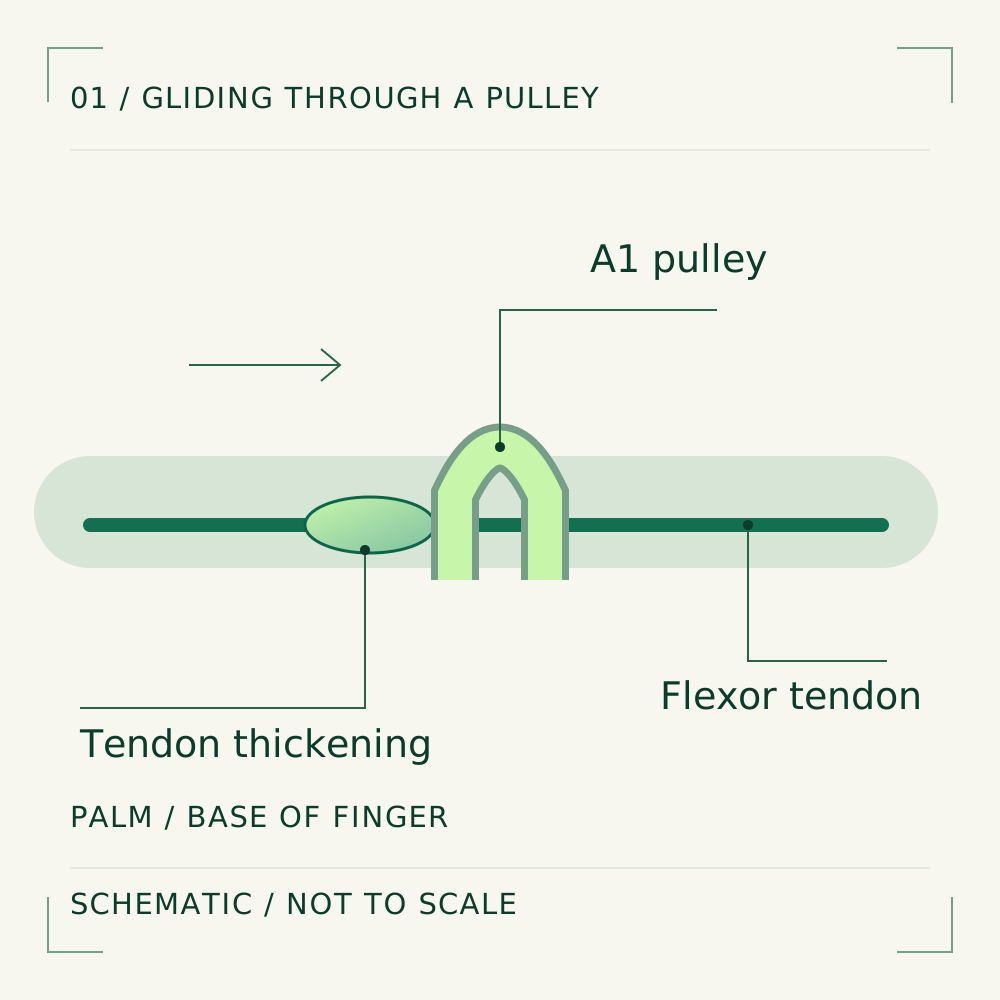
Flexor tendons bend the fingers and thumb. They glide through a sheath, held close to the bones by bands called pulleys. In trigger finger, thickening around the tendon and its A1 pulley at the finger’s base can interrupt this glide, producing a catch or lock.
1What you might notice
Tenderness or a small sensitive lump may develop in the palm at the finger’s base. Symptoms vary from an occasional click to difficulty straightening the digit.
- Catching or locking as the finger bends and straightens.
- Stiffness after sleep or a period of rest.
- Pain with gripping or pressure over the base of the finger.
Why the tendon starts to catch
Often there is no single identifiable cause. A mismatch between the tendon and its pulley restricts movement. Repeated forceful gripping can aggravate symptoms, but an association with hand use does not establish that someone’s work caused the condition.
3A pattern, not a requirement
Trigger finger can affect any digit, more than one finger, or both hands. It is more common in middle and later adulthood and in women. Diabetes and rheumatoid arthritis are recognised associations; having one of these conditions does not mean triggering is inevitable.
2Often worse after rest
Morning stiffness can be particularly troublesome. The finger may move more freely once it is gently moving, then catch again during repeated gripping. Do not repeatedly force a painful locked finger straight; a fixed lock needs prompt review.
4Understanding the problem.
Choosing the next step.
Usually a clinical diagnosis
Assessment includes opening and closing the hand, feeling along the tendon and checking the tender pulley. The clinician looks for catching and for loss of movement from other causes. Your description is useful if triggering is intermittent and does not occur during the appointment.
5When tests add value
A typical trigger finger usually needs no scan or X-ray. Further investigation is considered if examination suggests another problem or the presentation is unusual. The decision is based on the clinical findings, rather than an automatic imaging package.
1Reduce irritation and preserve comfortable movement
Changing forceful or repetitive gripping may help. A suitable night splint can rest the affected finger, and gentle movement may ease stiffness. Pain relief is considered according to individual suitability. These measures aim to improve comfort and function without forcing the tendon through a painful catch.
5What a steroid injection can do
An injection around the tendon sheath can reduce swelling and improve glide. Relief may be temporary or incomplete, and response can be lower in people with diabetes. Discuss skin changes, infection risk and a possible temporary rise in blood glucose before treatment.
1Releasing the tight pulley
Persistent symptoms, recurrent locking or a fixed bent finger may justify release of the A1 pulley. This creates more space for the tendon. Open release and selected needle-based techniques have different considerations; the surgeon discusses the appropriate approach and risks, including stiffness, scar sensitivity, nerve injury and incomplete relief.
3Comfort, movement and the demands of work
After release, gentle finger movement is usually encouraged as directed. Wound care and swelling control matter; scar tenderness can outlast wound healing. Light use often returns before heavy gripping. Timing depends on the digit, pre-existing stiffness, wound recovery and the physical demands of work or sport.
4When to arrange specialist assessment
Seek assessment when pain or locking interrupts daily use, symptoms persist despite simple changes, or movement is becoming limited. A finger stuck bent that cannot be straightened deserves prompt review. After surgery, increasing redness, discharge, fever or worsening pain should be reported to the treating team.
402 / THE THUMB SIDE OF THE WRISTThumb tendons & their tunnel
De Quervain’s
Tenosynovitis
What it is
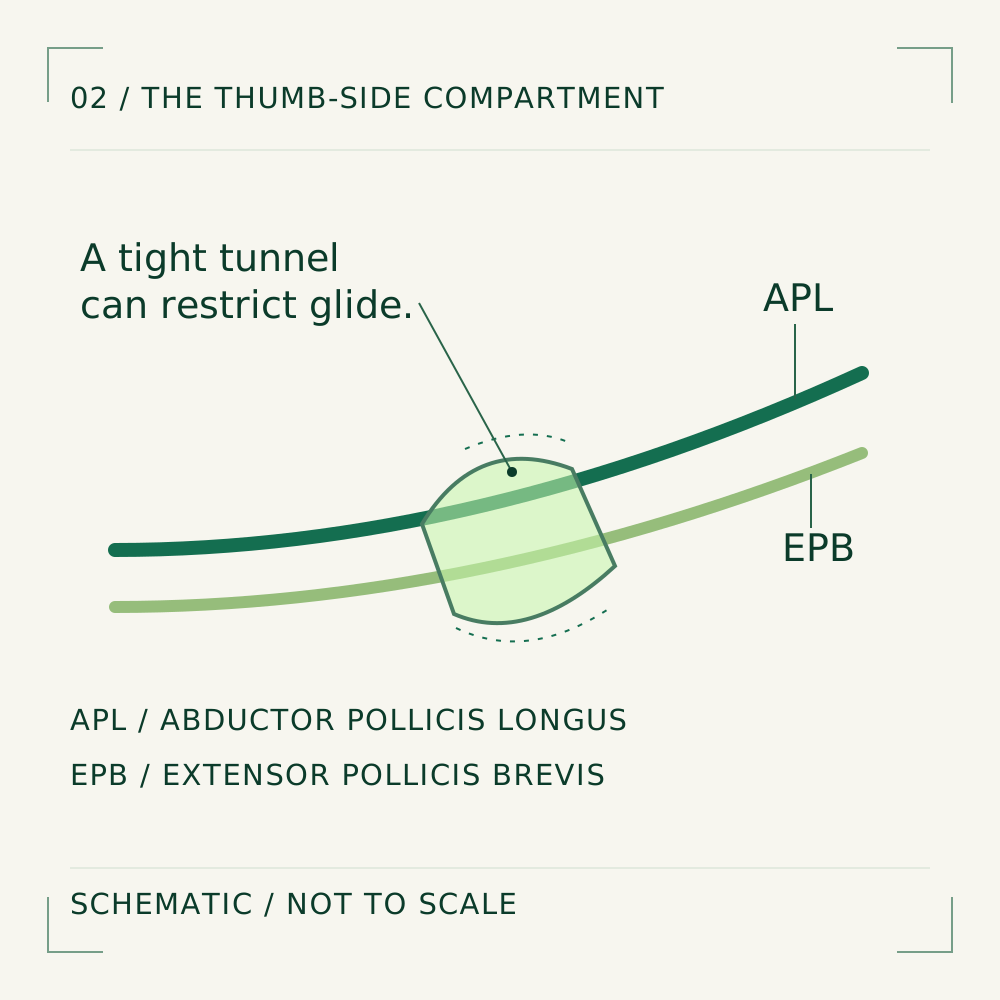
De Quervain’s affects two tendons that move the thumb: the abductor pollicis longus and extensor pollicis brevis. They pass together through a tunnel at the thumb side of the wrist. Thickening or irritation within this compartment can make tendon movement painful.
6Pain during everyday hand use
Pain is usually felt near the thumb-side wrist and may travel into the forearm. Swelling or a catching sensation can occur. Gripping, opening a container, lifting a child or moving the thumb away from the hand may become uncomfortable.
8Irritation within a confined space
Repetitive thumb and wrist movements may aggravate the tendon sheath. Previous injury or inflammatory conditions can sometimes contribute, but a clear cause is not always found. Treatment considers both the local findings and the activities that repeatedly reproduce the pain.
8Work, daily tasks and caring for a baby
De Quervain’s is more common in women and may occur during pregnancy or while caring for a young baby. Repeated lifting or sustained thumb positions can be relevant. These associations help guide practical changes; they are not a reason to blame ordinary hand use.
7Changing the task, not only the load
Symptoms may increase with repeated lifting, pinching or wringing, particularly when the wrist is bent at the same time. Note the position that hurts and consider a different grip or support for the load. Repeatedly provoking pain to test the wrist can keep it irritated.
8Understanding the problem.
Choosing the next step.
A targeted thumb and wrist examination
The clinician checks local tenderness, swelling and thumb movement. Controlled provocation manoeuvres, including a Finkelstein test, may help reproduce the pattern. These tests require interpretation alongside the examination; there is no need to perform forceful self-tests at home.
9Imaging is not always necessary
Typical cases can usually be diagnosed clinically. Imaging is selected when the diagnosis is uncertain or another wrist or thumb problem needs to be considered. A painful area alone does not establish which tissue is responsible.
6Rest the compartment while keeping a useful hand
An appropriate splint supports both the wrist and thumb. Reducing painful tasks, adapting lifting technique and therapist-guided activity changes can help. Pain relief or anti-inflammatory medicines may be considered after checking suitability. Rehabilitation is adjusted to symptoms rather than pushing through repeated pain.
9A targeted option for continuing symptoms
A steroid injection into the affected tendon compartment may settle irritation when simple measures are insufficient. The clinician discusses expected benefit and risks, including temporary discomfort and skin colour or thinning changes. A further review checks whether pain and hand use have improved.
7Creating more room for the tendons
For persistent, function-limiting symptoms, surgery may open the constricting compartment so the tendons move more freely. Nearby sensory nerve branches need protection. Possible problems include scar sensitivity, numbness, infection and continuing discomfort; surgery is considered after an individual assessment.
7A gradual return to gripping and lifting
After either non-surgical treatment or release, return to activity is guided by pain, movement and the demands of the task. Wound protection may be needed after surgery. Hand therapy can guide appropriate movement and gradual loading; improvement does not follow one fixed timetable for everyone.
9When persistent thumb-side pain needs review
Arrange assessment if pain or swelling continues, lifting and gripping remain difficult, or initial measures have not helped. New or changing symptoms should be reassessed rather than assumed to be the same problem. Treatment is directed at the confirmed clinical pattern.
9THE NEXT CHAPTER / YOUR CARE
When hand movement changes, understanding comes first.
A specialist assessment can distinguish a catching finger from a painful thumb-side tendon compartment and guide a treatment plan around your daily needs.
Book a Consultation