03.02 / TENDON & SOFT TISSUE
Tendon
Injuries
Bending and straightening depend on continuous tendon connections. When one is injured, a small wound or a subtle change in movement can matter. Assessment, precise protection and rehabilitation belong to the same treatment plan.
01 / THE PALM SIDE OF THE HANDBending & grip
Flexor Tendon
Injury
What it is
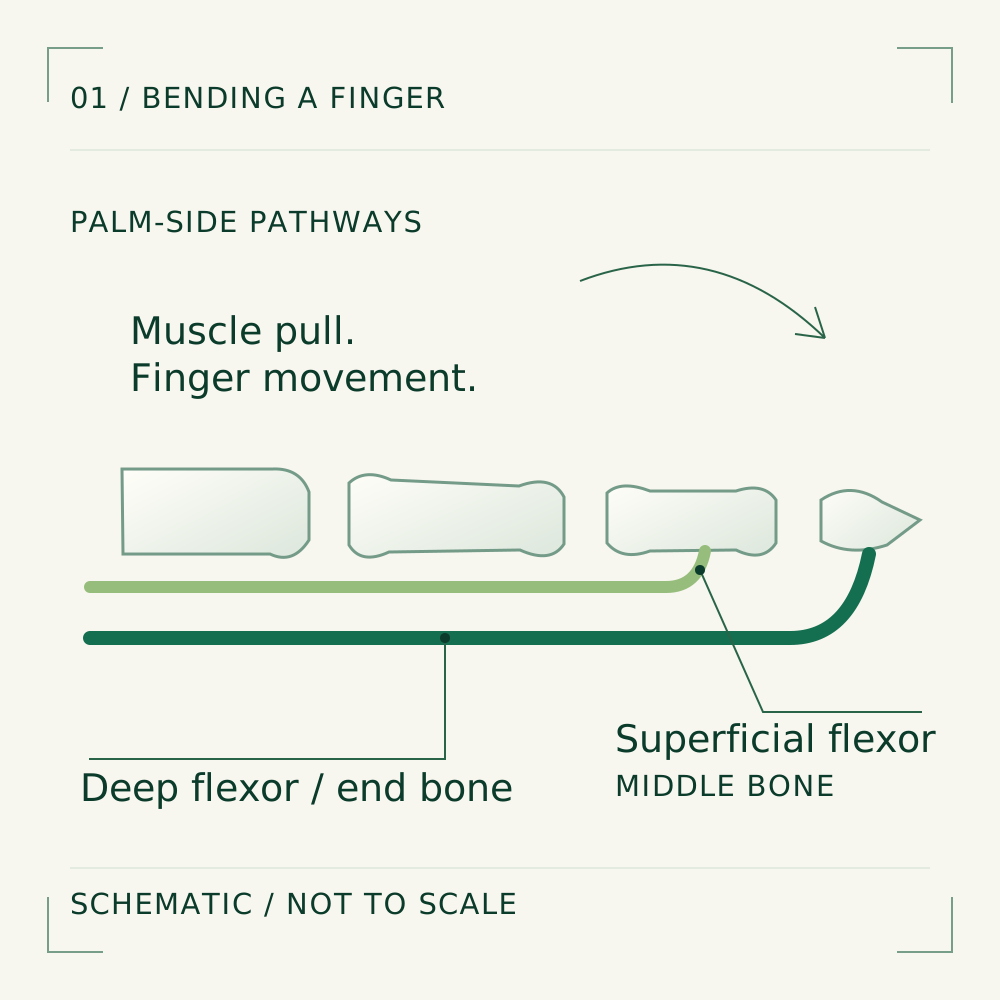
Flexor tendons connect muscles to the finger and thumb bones, allowing bending and grip. Most fingers have two flexor tendons, with different attachments. A cut or rupture can interrupt this connection, even when the skin wound looks small. Nearby nerves and blood vessels may also be injured.
1Changes after an injury
A finger may not bend normally at one or more joints. Pain, swelling or tenderness along the palm-side tendon can accompany the loss of movement. Numbness may suggest an associated nerve injury. The exact deficit depends on which tendon and other structures are involved.
2Cuts, a sudden pull or a crush
Glass, knives and other sharp objects can divide a tendon. A force that straightens a finger while it is gripping firmly can pull a flexor tendon from the bone, as in a jersey injury during sport. Crushing trauma can injure several tissues together.
3The wound can underestimate the injury
Domestic, sporting and workplace injuries can damage tendons. A small palm-side cut or a closed injury with altered movement can be significant.
1Assessment should not wait for the swelling to settle
New difficulty bending a finger after a cut or forceful injury needs prompt, preferably same-day assessment. A pale or cold finger, uncontrolled bleeding or loss of circulation requires emergency care. Timing of repair is decided after examination; do not delay seeking help because an operation may be scheduled later.
2Understanding the problem.
Choosing the next step.
Checking each tendon and the whole finger
Assessment tests bending at individual joints and checks sensation and circulation. The wound, mechanism and resting finger posture help identify the injury. The specialist also looks for damage to bone, joints and other soft tissues rather than treating tendon movement in isolation.
1When imaging changes the plan
X-rays may identify a fracture or certain retained foreign bodies. Ultrasound or other imaging can be useful in selected uncertain cases. These investigations support clinical assessment; they do not replace careful examination of a wound and the structures that may have been injured.
3Only selected injuries are suitable
Some partial tendon injuries can be managed with protection and supervised therapy after their extent and stability have been assessed. A completely divided tendon generally needs repair to restore the connection. A splint alone should not be assumed to make a severed tendon join back together.
2Reconnecting the tendon
Repair brings the divided ends together with carefully placed sutures; a tendon pulled from bone may need reattachment. Wound contamination and associated injuries influence the plan. Delayed or complex cases can require a different reconstructive strategy. The repair must then be protected while healing develops.
3Protection and controlled glide work together
A hand therapist provides a protective splint and a specific programme of permitted movement. Early exercises are controlled to help the tendon glide without overloading the repair. Do not substitute online exercises, remove the splint early or test your grip to see whether the repair is strong.
4Healing is measured in stages
Early repair strength is limited. Splint use and activity restrictions commonly continue for weeks, with strength and useful movement recovering over months. The schedule depends on injury level, repair and associated damage. Light duties, driving, manual work and sport each need a separate discussion with the treating team.
5Why follow-up and therapy matter
Scar tissue can restrict tendon glide, and stiffness or incomplete bending may remain. Too much load can rupture a repair; too little appropriate movement can contribute to adhesions. Some patients need further treatment. The rehabilitation plan balances these risks rather than pursuing movement as quickly as possible.
5Changes during recovery need attention
02 / THE BACK OF THE HANDStraightening & balance
Extensor Tendon
Injury
What it is
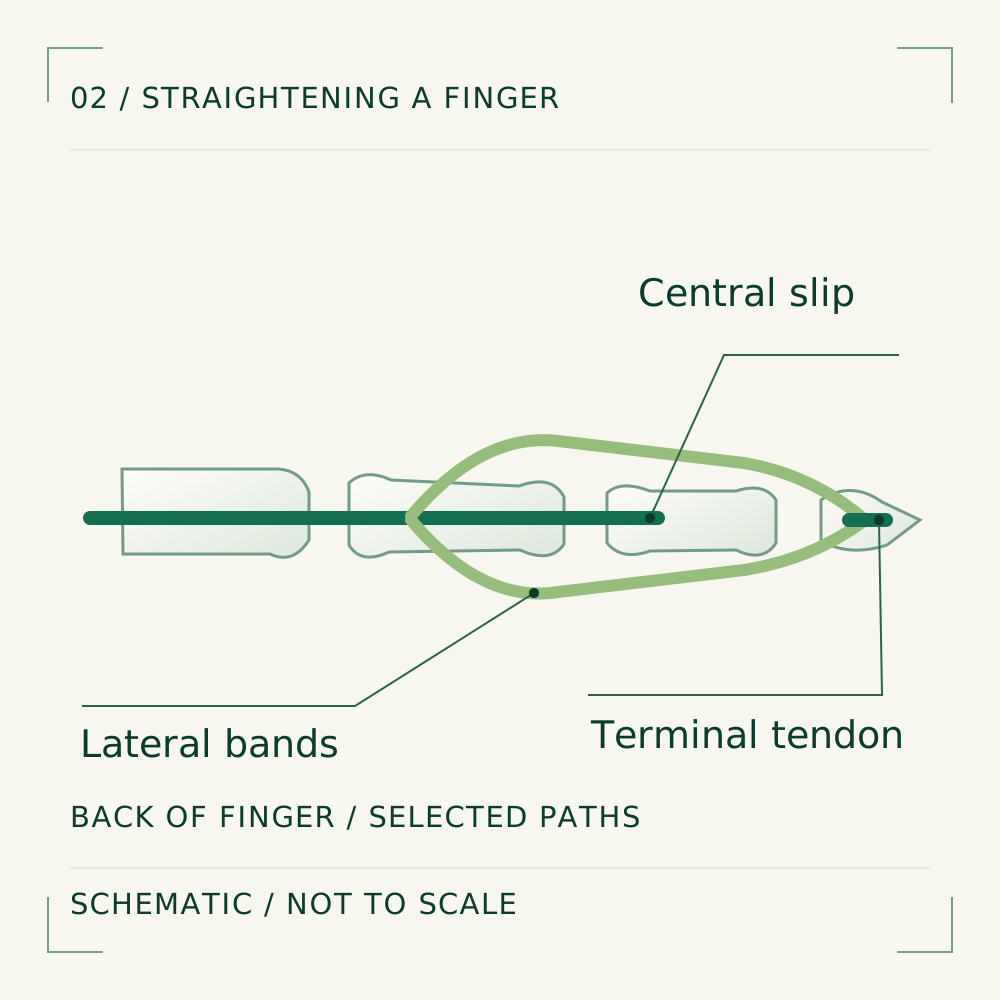
Extensor tendons run across the back of the hand and fingers to help straighten them. They lie close to the skin and spread into a delicate mechanism over the finger joints. Injury can affect the main tendon, the central slip at the middle joint or the terminal tendon at the fingertip.
7Difficulty straightening a finger or thumb
Pain and swelling may accompany a cut or closed injury. Loss of full straightening can involve the fingertip, middle joint or a larger part of the digit. Some injuries initially look subtle, so continuing weakness after trauma warrants reassessment.
9A cut is not the only mechanism
A wound on the back of the hand or finger can reach the superficial tendon. A ball striking the fingertip may rupture the terminal tendon without breaking the skin. Trauma can also damage the central slip or involve a fracture and joint injury.
9A jammed finger can involve the tendon mechanism
Central slip injuries may follow a finger being forced into a bent position during sport or other trauma. The characteristic bent middle joint and overextended fingertip can develop later, rather than being obvious at the first examination. Persistent symptoms after a jammed finger deserve review.
10Different levels need different protection
Mallet injury affects the tendon that straightens the end joint. A central slip injury affects control of the middle joint and can lead to a boutonnière pattern. These are not interchangeable injuries: splint position and the joints allowed to move depend on the structure affected.
10Understanding the problem.
Choosing the next step.
Locate the injured part of the mechanism
The clinician examines the wound, active extension, joint position and tendon function. Assessment also considers sensation, circulation and associated joint damage. A loss of movement after a cut or impact needs early review; the size of a wound does not establish the depth of injury.
9Check the joint and its bony attachments
X-rays help identify a tendon-related bone fragment, fracture or altered joint alignment. With suspected central slip injury, further assessment or ultrasound may be useful in selected cases. Imaging is chosen for the suspected pattern rather than required for every tendon injury.
10A splint can be the main treatment
When repair or fixation is needed
Open tendon injuries commonly require repair after the wound is assessed and cleaned. Certain associated fractures, joint misalignment or unsuitable closed injuries may also require surgery. The procedure depends on the level and extent of damage; an operation does not remove the need for careful splinting and rehabilitation.
3Follow the programme for this injury
After repair, a custom splint protects healing tissue while the therapist introduces permitted exercises. Timing differs by tendon zone and repair. Follow the demonstrated movements and restrictions exactly. Do not independently add stretching or strengthening because the hand feels less painful.
6Useful movement returns gradually
Repaired tendons remain vulnerable early on. Recovery commonly takes months, and some stiffness or an extension lag can persist. Hand therapy guides swelling control, safe glide and later loading. Return to manual tasks or sport depends on the repair and functional progress, not the calendar alone.
6When to seek urgent review
Seek prompt assessment for a new inability to straighten a finger or thumb after trauma, especially with a wound. During rehabilitation, contact the treating team for a sudden snap, loss of extension, increasing redness, wound discharge or worsening pain. A damaged or uncomfortable splint also needs review.
6THE NEXT CHAPTER / YOUR CARE
A change in movement after injury deserves timely assessment.
A specialist review identifies the injured structures and the protection or repair they need. New loss of movement after a cut or trauma needs prompt assessment rather than waiting for a routine appointment.
Book a Consultation